

Introduction: Navigating the Keyword Research Landscape
In the dynamic world of digital marketing, standing out online hinges on understanding what your audience is searching for. This is the fundamental purpose of keyword research, a critical discipline that forms the bedrock of any successful Search Engine Optimization (SEO) strategy. Navigating the vast landscape of available keyword research tools can be daunting, especially when faced with the perennial question: are free tools sufficient, or is investing in paid platforms a necessity? This article embarks on a deep dive, dissecting the strengths and weaknesses of both free and paid keyword research tools, and critically, it will reveal a winner.
The Foundation of SEO Success: Why Keyword Research Matters
At its core, SEO is about making your website visible to users searching for information, products, or services you offer. Keyword research is the process of identifying these terms and phrases, understanding their search volume, competition, and, crucially, the intent behind the user’s query. Effective keyword research informs every aspect of your online presence, from the content you create to the structure of your website and the optimization of individual page elements.
Without a solid keyword strategy, your digital marketing efforts are akin to shouting into the void. You might be producing excellent content, but if it doesn’t align with what potential users are actively searching for on Google and other search engines, your efforts to drive traffic will be significantly hampered. In fact, 91% of organizations reported that SEO positively impacted website performance and marketing goals in 2024, a testament to the foundational importance of robust SEO practices, with keyword research leading the charge. Organic search, driven by strategic keyword targeting, drives 300% more traffic to websites than social media, underscoring its unparalleled power in attracting an engaged audience.
The Perennial Dilemma: Free vs. Paid Keyword Research Tools
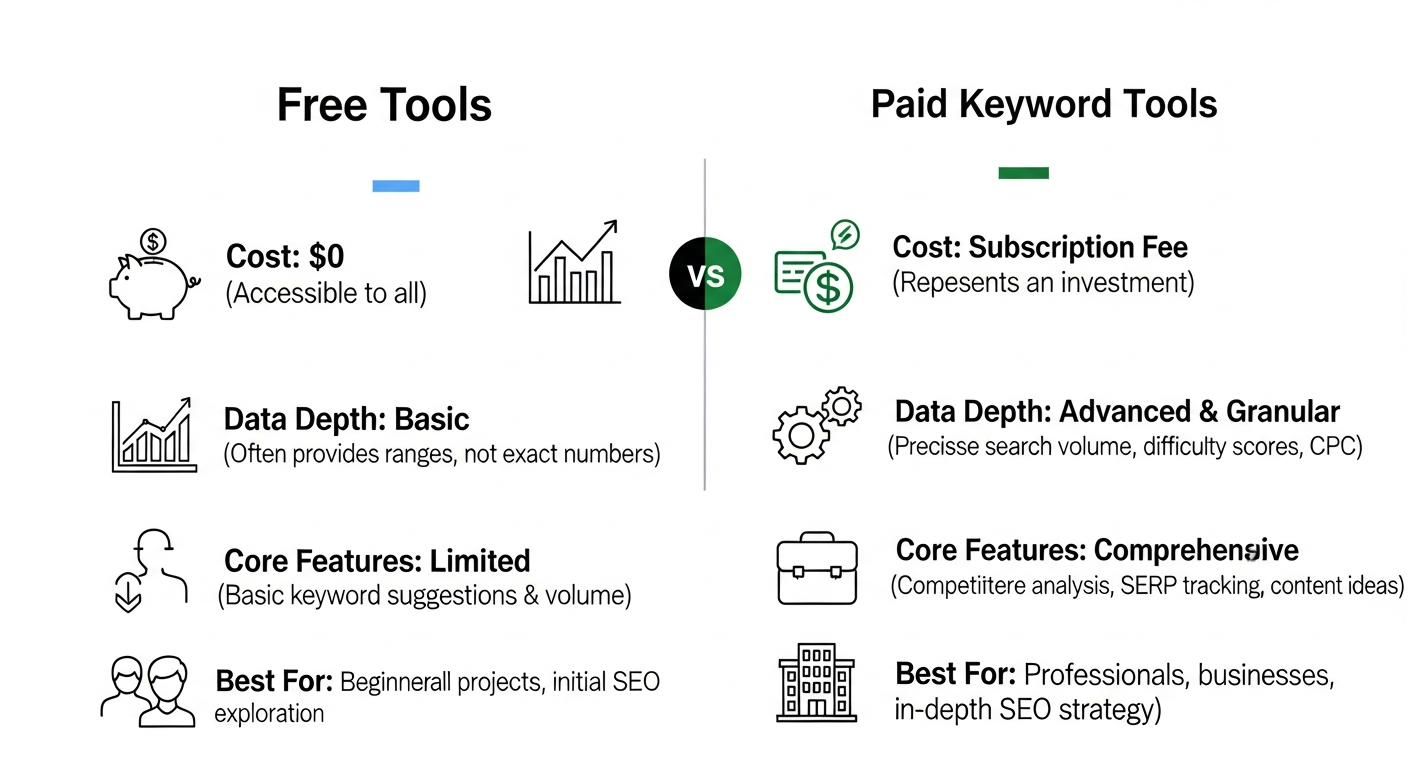 A head-to-head comparison of the key trade-offs between free and paid keyword research platforms.
The market offers a bewildering array of keyword research tools, ranging from entirely free utilities to comprehensive, subscription-based platforms. This presents a significant dilemma for businesses and marketers. Free tools offer immediate accessibility and can provide valuable insights, especially for beginners or those with tight budgets. They are excellent for initial exploration and basic data gathering. However, they often come with limitations in terms of data depth, accuracy, feature sets, and the sheer volume of insights they can provide.
Paid keyword research tools, on the other hand, represent a significant investment. They typically offer more sophisticated data analysis, larger keyword databases, advanced search volume and keyword difficulty metrics, competitive analysis features, and often integrate with other SEO functionalities. The question is not simply whether free tools are “good enough,” but rather, when does the complexity and scale of your SEO goals necessitate the advanced capabilities and deeper data offered by paid platforms?
What This Deep Dive Will Cover (and How We’ll Crown a Winner)
This article will provide a comprehensive comparison of free and paid keyword research tools. We will explore the essential concepts that underpin effective keyword research, delve into the most impactful free tools available, and then examine the leading paid platforms that dominate the professional SEO landscape. A dedicated section will then pit free against paid head-to-head, analyzing key differentiators. Ultimately, based on a transparent evaluation framework, we will crown a winner, or perhaps a tiered set of winners, to guide your decision-making. Our objective is to equip you with the knowledge to select the right tools for your specific needs and budget, ensuring your content ranks higher and drives more traffic.
The Non-Negotiable Core: Understanding Essential Keyword Research Concepts
Before diving into specific tools, it’s crucial to grasp the fundamental principles of keyword research. These concepts are universally applicable, regardless of the platform you choose.
Defining Keyword Research: More Than Just Words
Keyword research is the practice of identifying the words and phrases (keywords) that people use in search engines when looking for information related to your business, products, or services. It’s about understanding the language of your target audience. These keywords are not just random terms; they are the bridges connecting a user‘s need with the content you provide on your website. This process goes beyond simple word association to uncover the true queries driving search and potential traffic.
Key Metrics for Keyword Evaluation: Search Volume, Keyword Difficulty, & Competition Levels
When evaluating potential keywords, several metrics are paramount:
- Search Volume: This indicates how many times a specific keyword is searched for within a given period, typically per month. Higher search volume generally means more potential traffic, but it often correlates with higher competition. Accurately interpreting search volume data is key.
- Keyword Difficulty (KD): This metric estimates how hard it will be to rank for a particular keyword in the SERPs. It’s often calculated based on the authority and backlink profiles of the pages currently ranking for that term. A lower keyword difficulty suggests it’s easier to achieve visibility.
- Competition Levels: Related to keyword difficulty, this metric often refers to the number and quality of advertisers bidding on a keyword (in paid search) or the number of organic pages vying for top positions.
Understanding these metrics helps prioritize keywords that offer a balance of potential traffic and achievable ranking opportunities.
Decoding Search Intent: The User’s “Why” Behind Every Search
Perhaps the most critical aspect of modern keyword research is understanding search intent. This refers to the underlying reason or goal a user has when typing a query into a search engine. Is the user looking to learn something (informational), find a specific website (navigational), compare products (commercial), or make a purchase (transactional)?
Ignoring search intent means creating content that might be irrelevant to what the user actually wants, leading to high bounce rates and poor SERPs performance. Tools that help uncover intent, such as those that visualize user questions, are invaluable. For instance, 50% of Google searchers click on a search result within 9 seconds, while 25% do so within just 5 seconds, illustrating the speed at which users make decisions on SERPs, making accurate intent matching crucial.
The Role of Keywords in Your Overall SEO Strategy and Content Marketing
Keywords are not just for search engines; they are central to creating effective content that resonates with your audience. By understanding the keywords your target audience uses, you can tailor your content marketing strategy to address their specific needs, questions, and pain points. This leads to more relevant and engaging content, which in turn signals to Google that your website is a valuable resource. Ultimately, this drives higher rankings, increased traffic, and better conversion rates, contributing to the 91% of organizations reporting positive impacts on website performance and marketing goals from SEO in 2024.
The Free Frontier: Top Keyword Research Tools That Won’t Break the Bank
For those starting out or operating on a limited budget, a wealth of free keyword research tools can provide significant value. These tools are excellent for initial data exploration, generating content ideas, and understanding basic search volume and keyword difficulty.
Google Keyword Planner: The Gold Standard for Google Ads & Volume Insights
While primarily designed for advertisers, Google Keyword Planner remains an indispensable free tool for keyword research. It provides search volume data and competitive insights directly from Google, making it highly relevant for organic SEO. Its primary limitation for non-advertisers is that search volume data is often presented in broad ranges unless you have active Google Ads campaigns. Nevertheless, it’s a foundational tool for understanding general search interest.
Google Search Console: Unearthing Your Current Performance & Opportunities
Google Search Console is a free platform from Google that helps you monitor your website‘s performance in Google Search. Its “Performance” report reveals the actual keywords users are searching for to find your website, along with impressions, clicks, and average position. This is invaluable for identifying overlooked keywords and content gaps based on your existing traffic.
Google Trends: Spotting Search Trends and Seasonal Demand
Google Trends allows you to visualize the popularity of search queries over time and across different regions. This tool is excellent for identifying seasonal trends, understanding the relative popularity of different keywords, and spotting emerging topics that could inform your content strategy. It helps in understanding the “why” and “when” behind certain searches.
AnswerThePublic: Visualizing Questions, Prepositions, and Comparisons (User Intent)
AnswerThePublic is a visually engaging tool that transforms keyword research into question-based insights. It mines Google’s autocomplete data to generate lists of questions, prepositions, comparisons, and alphabetical lists related to a seed keyword. This tool is exceptionally powerful for understanding user search intent and generating comprehensive content ideas that directly answer audience questions.
Ubersuggest (Free Tier): Quick Keyword Suggestions and Basic Metrics
Ubersuggest, while offering a robust paid version, provides a useful free tier that delivers quick keyword suggestions, basic search volume estimates, and keyword difficulty scores. It’s a good starting point for generating a broad list of keywords and getting a general sense of their viability. However, the free tier has significant limitations on daily searches and data depth.
Google Autocomplete & “People Also Ask”: Organic Content Ideas
The Google autocomplete suggestions that appear as you type in the search bar, and the “People Also Ask” (PAA) boxes that appear in SERPs, are organic sources of keyword ideas. They reflect real-time user queries and are excellent for discovering long-tail keywords and understanding the natural language users employ. These are invaluable for content ideation and ensuring your content addresses the nuances of search.
The Power of Free Tool Stacks: Combining Multiple Tools for Comprehensive Insights
The true power of free keyword research tools lies in their synergistic application. By combining Google Keyword Planner for search volume, AnswerThePublic for user intent, Google Search Console for existing performance data, and Google Trends for temporal insights, you can build a surprisingly comprehensive keyword research strategy without incurring any costs. This “stacking” approach allows for a more rounded understanding of keywords and their potential impact on your website traffic.
Investing for Impact: Leading Paid Keyword Research Platforms for Serious SEOs
When your keyword research needs move beyond basic exploration and into strategic growth, paid platforms become essential. These tools offer unparalleled data depth, advanced features, and integrated workflows that can significantly boost SEO efficiency and effectiveness. The Enterprise SEO Platforms Market was valued at $4.38 billion in 2024 and is anticipated to reach $12.5 billion by 2032, growing at a CAGR of 14% 30 Enterprise SEO Statistics, 2026, indicating substantial investment in these sophisticated solutions.
Semrush: The All-in-One Digital Marketing Powerhouse
Semrush is a comprehensive digital marketing platform that excels in keyword research. Its “Keyword Magic Tool” offers a vast database of keywords, advanced filtering options, and detailed metrics including search volume, keyword difficulty, and CPC data. Beyond core keyword research, Semrush provides robust competitor analysis, content marketing tools, backlink analysis, and SERPs tracking, making it a true all-in-one solution for serious SEO professionals.
Ahrefs: Backlink Dominance and Unparalleled Keyword Depth
Renowned for its industry-leading backlink index, Ahrefs also boasts one of the most extensive keyword research databases available. Its “Keywords Explorer” offers detailed insights into search volume, keyword difficulty, clicks data, and the ability to analyze the SERPs for any keyword. Ahrefs is particularly strong for in-depth competitor keyword analysis and understanding the backlink landscape that influences rankings.
Moz Keyword Explorer: User-Friendly Authority with Actionable Metrics
Moz Keyword Explorer is lauded for its user-friendly interface and actionable metrics. It provides search volume, keyword difficulty, opportunity scores (a blend of volume and difficulty), and vital relevance data. Moz also offers excellent SERPs analysis and insights into keyword prioritization, making it a strong contender for users who value clarity and actionable recommendations.
KWFinder (Mangools): Simplicity Meets Value for Niche & Local SEO
KWFinder by Mangools is designed for simplicity and offers excellent value, particularly for niche and local SEO. It provides accurate search volume, keyword difficulty, and CPC data in a clean interface. Its strength lies in identifying long-tail keywords and providing clear SERPs analysis, making it accessible for users of all skill levels.
SE Ranking: A Balanced Contender for All-in-One SEO
SE Ranking offers a balanced suite of SEO tools, including a powerful keyword research module. It provides comprehensive keyword suggestions, accurate search volume and keyword difficulty metrics, and detailed SERPs analysis. Its appeal lies in its affordability and the integration of keyword research with other essential SEO platform features like website auditing and rank tracking.
Specialized & Niche Paid Tools (Brief Overview)
Beyond these major platforms, numerous specialized tools exist, such as Surfer SEO for on-page optimization based on SERPs data, or MarketMuse for advanced content strategy and keyword gap analysis. These often complement broader keyword research platforms by offering deeper dives into specific aspects of SEO.
Free vs. Paid: A Head-to-Head Comparison & When to Upgrade
The decision between free and paid keyword research tools boils down to a careful consideration of data quality, feature breadth, workflow efficiency, and return on investment (ROI).
Data Depth, Accuracy, and Freshness: Where Paid Tools Excel
Paid platforms generally offer access to larger, more frequently updated keyword databases. The data search volume, keyword difficulty, and competitive metrics are often more granular and accurate. Free tools, particularly Google Keyword Planner, can sometimes provide broad ranges for search volume and may not offer the same depth of historical data or real-time SERPs analysis that paid solutions provide. For businesses where precise data and up-to-the-minute insights are critical for driving traffic and conversions, the investment in paid tools is often justified.
Feature Set & Scope: From Basic Keyword Suggestions to Full SEO Strategy Suites
Free tools are typically focused on the core task of keyword generation and basic data analysis. Paid platforms, however, offer a much broader feature set. This includes advanced competitor keyword analysis, backlink profiling, content optimization suggestions based on top-ranking pages, SERPs feature analysis (like featured snippets), and integration with website auditing tools. For an integrated SEO strategy that encompasses more than just keyword research, paid platforms are indispensable.
Workflow Efficiency & Automation: Streamlining Your Keyword Research Process
For professionals and agencies managing multiple websites or complex content strategies, workflow efficiency is paramount. Paid keyword research tools often incorporate features for project management, team collaboration, automated reporting, and integration with other marketing platforms. This automation and streamlining save significant time, allowing teams to focus on strategy and execution rather than manual data collection and analysis. This efficiency is critical when considering the high ROI of SEO, where businesses can expect an ROI of $22 for every $1 spent on SEO, compared to paid ads which deliver a lower ROI of $2 for every $1 spent Stratifi Creative, 2025.
The Cost-Benefit Analysis: Calculating the ROI of Paid Subscriptions
The Global SEO Software Market size was estimated at USD 74.6 billion in 2024 and is projected to reach USD 154.6 billion by 2030, growing at a CAGR of 13.5% from 2025 to 2030 Grand View Research, 2024. This growth reflects the significant value placed on these tools. While paid platforms have subscription fees, their ability to uncover high-converting keywords, identify content gaps, and optimize for traffic often leads to substantial returns. When a free tool‘s limitations hinder your ability to gain a competitive edge or drive meaningful traffic, the investment in a paid platform typically pays for itself through increased visibility and customer acquisition. Furthermore, over 86% of SEO experts have integrated AI technology or tools into their strategies WordStream, 2026, highlighting that advanced, often paid, solutions are becoming standard for staying competitive.
Advanced Strategies & Future Trends
The landscape of search is constantly evolving. Modern keyword research must account for AI integration, voice search, and the increasing prevalence of zero-click searches.
Mastering Search Intent and AI Integration
As mentioned, search intent is king. Leading paid platforms are increasingly integrating AI to provide deeper search intent analysis, predict trends, and offer more sophisticated content gap identification. These AI-driven insights help create highly targeted content that satisfies user needs at every stage of the customer journey, from initial awareness to final conversion.
Voice Search and Zero-Click Searches
The rise of voice search necessitates a focus on conversational keywords and natural language queries. Simultaneously, the increase in zero-click searches (where users find answers directly in SERPs without clicking through to a website) means optimizing for featured snippets and rich results is paramount, a capability often enhanced by advanced paid tools.
The Winner Revealed
Navigating the world of keyword research tools presents a clear fork in the road: the accessible free options versus the powerful paid platforms. Free tools like Google Keyword Planner, Google Search Console, and AnswerThePublic are invaluable starting points, excellent for basic data acquisition, content ideation, and understanding foundational search intent. They empower individuals and small businesses to begin their SEO journey effectively.
However, for serious SEO professionals, agencies, and businesses aiming for significant growth and a competitive edge, the investment in paid keyword research tools is not just beneficial; it’s often essential. The unparalleled data depth, advanced features for competitor analysis, nuanced keyword difficulty metrics, workflow automation, and AI-driven insights offered by platforms like Semrush and Ahrefs provide a level of strategic advantage that free tools simply cannot match.
Our Verdict:
While a single “winner” can be subjective based on specific needs, for comprehensive power, depth, and breadth of features that enable advanced SEO strategy and drive substantial traffic, Semrush and Ahrefs stand as the undisputed leaders in the paid category. They offer the most robust ecosystems for understanding keywords, analyzing competitors, and optimizing content for maximum visibility.
For those on a budget, the “winner” is not a single tool, but a strategic combination: Google Keyword Planner for initial volume insights, AnswerThePublic for deep user intent exploration, and Google Search Console to leverage existing website performance data.
The key takeaway is that keyword research is not a one-time task, but an ongoing process. Whether you start with free tools or invest in paid platforms, the ultimate goal remains the same: to understand your audience, connect with their search queries, and drive meaningful traffic to your website. Choose the tools that best align with your goals, budget, and ambition to conquer the SERPs.