

In today’s hyper-connected world, the digital landscape is the primary battleground for business growth. Potential customers are not just browsing; they are actively searching for solutions, products, and services on platforms like Google. Understanding how to effectively appear in these crucial search results is paramount. This is where the strategic interplay of Search Engine Optimisation (SEO) and Search Engine Marketing (SEM) comes into play. While both aim to increase online visibility and drive traffic to a website, they achieve this through fundamentally different approaches. For any business looking to thrive, navigating this distinction is not just beneficial; it’s essential.
The Core Dilemma for Business Growth
The fundamental challenge for businesses lies in allocating finite resources – time, budget, and human capital – to marketing strategies that yield the most significant return on investment. When it comes to search engines, two dominant paths emerge: earning organic visibility through SEO and purchasing visibility through SEM. The decision between focusing on one, the other, or a combination often depends on a business’s specific goals, stage of development, and competitive environment. Getting this decision wrong can lead to wasted marketing spend and missed opportunities, while the right strategy can unlock substantial, sustainable growth.
Why Understanding Both Strategies is Crucial
Without a clear understanding of SEO and SEM, businesses risk adopting a haphazard approach to their online marketing. SEO builds long-term credibility and a sustainable flow of organic traffic, acting as the bedrock of a strong online presence. Conversely, SEM offers immediate visibility and targeted reach, allowing businesses to capture demand as it arises. Both are powerful tools, but their strengths lie in different areas. Recognizing these nuances ensures that marketing efforts are aligned with business objectives, whether the immediate need is for rapid lead generation or the gradual establishment of brand authority.
What This Guide Will Cover
This comprehensive guide will demystify the often-confused realms of SEO and SEM. We will define each strategy in detail, followed by a direct comparison of their core differences in cost, time-to-results, traffic quality, and sustainability. Furthermore, we will explore the critical role of search intent and the user journey in informing your strategy. A practical decision framework will be provided to help you determine which approach, or combination thereof, is ideal for your specific business growth objectives. We will also examine real-world scenarios and conclude by highlighting the synergistic power of integrated search marketing.
Understanding the Fundamentals: SEO and SEM Defined
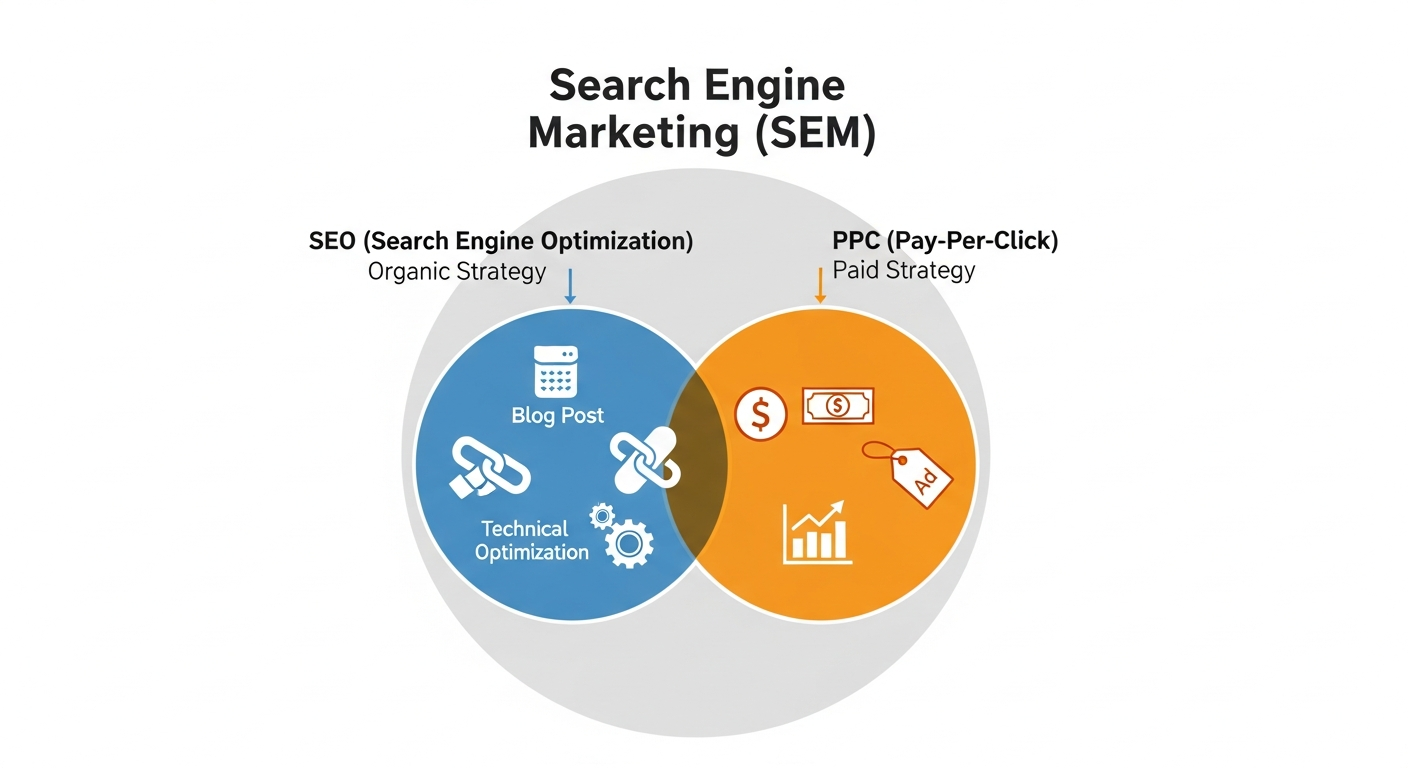 SEM encompasses both organic efforts (SEO) to earn traffic and paid efforts (PPC) to buy traffic.
At their core, both SEO and SEM are components of a broader digital marketing strategy aimed at improving a business’s presence on search engines. However, they differ significantly in their methodology and immediate impact.
What is Search Engine Optimization (SEO)?
Search Engine Optimization (SEO) is the practice of improving a website’s visibility in the unpaid, or “organic,” sections of search engine results pages (SERPs). The primary goal of SEO is to earn higher rankings by making a website more relevant and authoritative in the eyes of search engines like Google. This involves a multifaceted approach that includes optimizing website content with relevant keywords, improving site structure and technical performance, building high-quality backlinks from other reputable websites, and ensuring a positive user experience. The objective is to attract qualified organic traffic consistently over the long term. Global spending on SEO is substantial, projected to grow significantly, highlighting its enduring importance in the digital marketing ecosystem.
What is Search Engine Marketing (SEM)?
Search Engine Marketing (SEM) is a broader digital marketing strategy that encompasses both SEO and paid search advertising, primarily Pay-Per-Click (PPC). While SEO focuses on earning organic visibility, SEM utilizes paid placements to gain immediate exposure on search engine results pages. Businesses bid on keywords relevant to their products or services, and their advertisements appear when users search for those terms. A key benefit of SEM is its ability to deliver rapid, measurable results; for example, PPC advertising can yield average returns of $2 for every $1 spent, representing a 200% ROI. Global spending on search advertising is immense, projected to reach significant figures, underscoring SEM’s impact on immediate business growth.
SEO vs. SEM: A Direct Comparison of Key Differences
Understanding the distinct characteristics of SEO and SEM is crucial for making informed marketing decisions. While both contribute to online visibility, their operational mechanics, timelines, and cost structures vary significantly.
Cost Structure: Investment vs. Expenditure
SEO is fundamentally an investment. While it requires resources for content creation, technical optimization, and link building, the traffic generated is “free” in the sense that you don’t pay per click or impression once you achieve higher rankings. This builds long-term value. For instance, SEO delivers a median ROI of 748%, with organizations seeing substantial returns for every dollar invested. SEM, on the other hand, is an expenditure. Businesses pay for ad placements, typically on a cost-per-click (CPC) basis. While this offers immediate traffic, the flow of visitors ceases the moment advertising spend stops.
Time to Results: Patience vs. Urgency
One of the most significant distinctions is the timeframe for seeing results. SEO is a long-term strategy. Building authority, earning backlinks, and improving rankings take time, often months, before significant organic traffic begins to materialize. PPC, a core component of SEM, offers immediate visibility. As soon as campaigns are launched and bids are placed, ads can appear at the top of search results, driving traffic instantly. This is ideal for businesses needing quick lead generation or sales. PPC is particularly effective for generating immediate traffic and leads, in contrast to SEO which typically achieves positive ROI within 6 to 12 months.
Traffic Quality and Nature: Organic Trust vs. Targeted Intent
SEO traffic is often perceived as more trustworthy and credible by users. When a website ranks organically, it signifies to the search engine and the user that it is a relevant and authoritative source. This organic traffic tends to have a higher conversion rate; SEO leads have a 14.6% close rate, outperforming many other marketing channels. SEM traffic, while highly targeted through keyword selection and audience segmentation, comes from paid advertisements. Users clicking on ads may be aware they are clicking on a paid listing, but the immediate intent to purchase or engage is often very high, especially for transactional keywords.
Sustainability and Long-Term Value
The long-term value proposition heavily favors SEO. Once a website achieves strong organic rankings, it can continue to drive traffic and leads with minimal ongoing direct cost, making it a sustainable growth engine. This organic traffic accounts for 53% of all trackable traffic to websites. SEM traffic is directly tied to ad spend. When spending is cut, traffic stops. While SEM provides immediate wins, SEO builds an enduring online asset that continues to deliver value over time, supporting sustained business growth.
Control and Flexibility
SEM offers a high degree of control and flexibility. Advertisers can precisely target specific demographics, locations, devices, and even times of day. They can also readily adjust bids, ad copy, and landing pages to test what performs best, enabling rapid campaign optimization. SEO, while offering insights into user behavior and search trends, has less direct control over rankings. Algorithm updates from search engines can impact performance, and the iterative process of optimization is slower and less predictable than the immediate adjustments possible with paid campaigns.
Beyond Definitions: The Power of Search Intent and User Journey
Effective digital marketing hinges on understanding not just what users search for, but why they are searching. Search intent and the user journey are critical frameworks for aligning your SEO and SEM strategies for maximum impact.
Matching Strategy to User Intent
Users search with different intentions: to find information (informational), navigate to a known website (navigational), investigate a purchase (commercial investigation), or buy a product/service (transactional). Informational queries are typically best addressed with comprehensive, authoritative SEO content that establishes expertise. Navigational queries are often brand-specific and less relevant for broad SEM campaigns but can be targeted with branded SEM ads. Commercial investigation and transactional queries are prime candidates for both SEM (immediate purchase intent) and well-optimized SEO (capturing users researching solutions).
Keyword Research for Intent-Based Strategies
Keyword research is foundational to both SEO and SEM, but its application differs based on intent. For SEO, longer-tail, informational keywords can build authority and attract a broad audience. For SEM, high-intent, transactional keywords are often prioritized for immediate conversion. Analyzing search volume, competition, and associated user intent helps determine whether to focus on organic content creation or paid advertising bids. Tools that provide keyword difficulty and search intent analysis are invaluable for this process.
The Crucial Role of User Experience (UX)
A positive user experience (UX) is no longer just a nice-to-have; it’s a critical ranking factor for SEO and a key driver of conversion for SEM. For SEO, a website that is easy to navigate, loads quickly, and provides valuable content will rank higher and retain visitors longer. For SEM, the landing page where an ad directs a user must be relevant, user-friendly, and optimized for conversion. A poor UX on a landing page will not only waste ad spend but also negatively impact future ad quality scores, increasing costs. This underscores how core SEO principles like UX are intrinsically linked to overall SEM success.
Strategic Decision Framework: Which is Right for YOUR Business Growth?
Choosing between SEO and SEM, or deciding on their integration, requires a structured approach that aligns with your unique business context.
Step 1: Define Your Clear Business Goals
What do you want to achieve? Are you focused on brand awareness, lead generation, direct sales, customer retention, or market expansion? Your primary business goals will heavily influence your strategy. For immediate revenue generation, SEM might be prioritized. For long-term brand authority and sustainable growth, SEO will be a cornerstone.
Step 2: Assess Your Budget and Available Resources
How much can you realistically invest in marketing, both in terms of financial capital and internal resources (time, personnel, expertise)? SEO is an ongoing investment that builds over time, while SEM requires a continuous budget for ad spend. Consider your capacity to manage either or both effectively.
Step 3: Consider Your Timeframe for Desired Results
Do you need to see results within weeks, or are you building for the long haul? If immediate impact is critical, SEM is the more suitable option. If you have the luxury of time to build a lasting asset, SEO becomes a primary focus.
Step 4: Analyze Your Competitive Landscape
What are your competitors doing? Are they heavily invested in paid search? Do they dominate organic search results for key terms? Understanding their strategies can inform your own. If competitors are absent from paid search, there might be an opportunity for quick wins. If they own the organic space, breaking in will require a dedicated SEO effort.
Step 5: Understand Your Target Audience and Customer Journey
Who are your ideal customers, and how do they typically find solutions like yours online? Mapping their journey from initial awareness to final conversion will reveal the most effective touchpoints for both SEO and SEM. For instance, early-stage research might be best captured by SEO, while late-stage decision-making can be influenced by targeted SEM.
Real-World Scenarios: Applying SEO & SEM for Different Businesses
Let’s explore how these principles apply to various business types.
Scenario 1: The New E-commerce Store
A new e-commerce store needs to generate sales quickly to establish cash flow. A strong SEM strategy focusing on high-intent transactional keywords for specific products can drive immediate traffic and conversions. Simultaneously, foundational SEO on product pages and category pages is crucial for building long-term organic visibility and reducing reliance on paid ads over time.
Scenario 2: The Local Service Business (e.g., Plumber, Restaurant)
For businesses serving a specific geographic area, local SEO is paramount. Optimizing Google Business Profile, building local citations, and ensuring mobile-friendliness are key. SEM can be used for highly targeted local ad campaigns, especially for urgent service needs (e.g., “emergency plumber near me”).
Scenario 3: The SaaS/B2B Company
B2B sales cycles are often longer, and trust is built through expertise. A robust SEO strategy focused on valuable content marketing, addressing industry challenges, and establishing thought leadership is essential. SEM can be used to target specific professional titles or companies with highly tailored campaigns for lead generation.
Scenario 4: The Established Brand Seeking Expansion
An established brand looking to enter new markets or launch new products can leverage both strategies effectively. SEM can quickly generate awareness and initial sales in new territories. A concurrent SEO effort will build long-term organic presence, ensuring sustained growth and brand positioning in these new markets.
The Synergistic Power of Integrated Search Marketing
While SEO and SEM can be effective independently, their true power is unlocked when integrated. A significant 75% of professionals combine PPC with SEO to maximize results, recognizing the enhanced impact. This synergy allows businesses to capture users at all stages of their journey. SEM data can inform SEO strategy by revealing which keywords and ad creatives resonate most with target audiences. Conversely, strong SEO rankings can improve the quality score and performance of SEM campaigns by lending credibility to landing pages. The combination of organic and paid search makes up 80% of all trackable website visits, with a split of 53% organic and 27% paid, emphasizing the need to utilize both.
Conclusion
The question of “SEO vs. SEM” is not about choosing one over the other, but rather understanding how each contributes to your overarching business growth strategy. SEO offers a sustainable, cost-effective path to long-term visibility and authority, building a valuable online asset. SEM provides immediate impact, targeted reach, and rapid lead generation, ideal for capturing urgent demand and testing market responsiveness. For most businesses aiming for comprehensive growth, an integrated search marketing approach that leverages the strengths of both SEO and SEM is the most powerful strategy. By defining clear goals, understanding your audience, assessing your resources, and continually analyzing performance, you can craft a dynamic search strategy that drives consistent, meaningful business growth in the ever-evolving online landscape.