

The Evolving SEO Landscape in 2026
The online world is always changing. For businesses wanting to succeed online, keeping up with search engine optimisation (SEO) is not just helpful – it’s a must. As we look toward 2026, the very definition of SEO is being rewritten by the rapid integration of artificial intelligence. Gone are the days when optimising solely for traditional search engine algorithms was sufficient. The future demands a strategic approach that prioritises genuine value, user intent, and seamless integration with AI-driven search experiences. This roadmap will help you understand the important SEO best practices for 2026. It will make sure your website ranks well and does well in a smarter search world. This will increase your business’s visibility and support long-term growth.
The Evolving SEO Landscape in 2026
The year 2026 introduces a transformed SEO landscape, fundamentally influenced by artificial intelligence. Search engines are not just big lists of web pages anymore. They are becoming smart helpers that can understand complex questions and provide clear, concise answers. This big change requires us to rethink our main SEO strategies. We need to shift from just focusing on algorithms to emphasising user experience, reliable information, and how well content can be understood and used by AI.
The New Era of Search: AI’s Transformative Impact
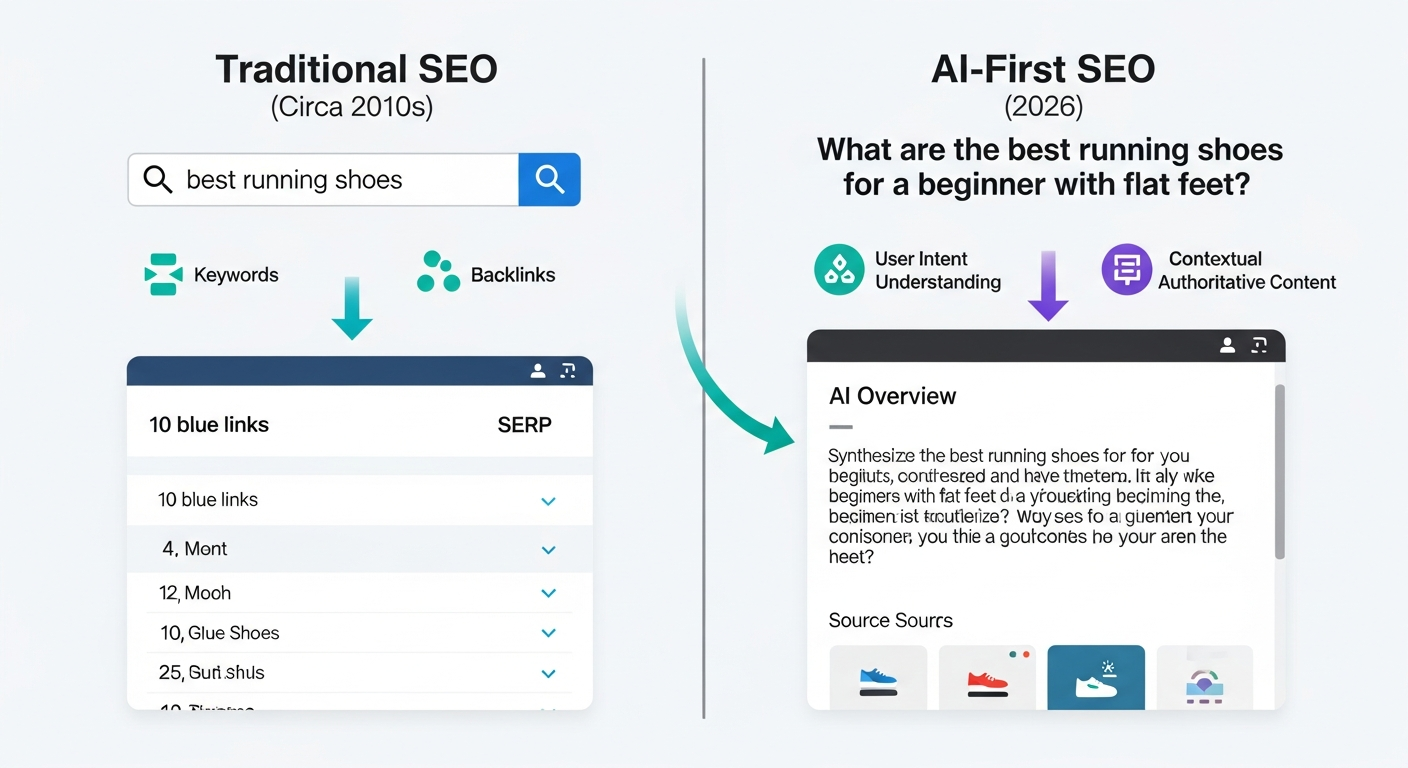
The evolution of search: from a list of links to direct, AI-synthesised answers.
Artificial intelligence is no longer a fringe technology; it’s now the driving force behind the evolution of search. Search engines, especially Google, are integrating AI capabilities to provide more predictive, conversational, and personalised search experiences.. This transition means that the way users find information and interact with search engines is fundamentally changing. The “10 blue links” model is changing. Now, AI gives summaries and direct answers. This change is affecting how websites get noticed and attract visitors. Understanding this transformation is the first step to building a robust SEO strategy for 2026.
Understanding the AI-First Search Environment
The search engine environment of 2026 is decidedly AI-first. Search engines are leveraging large language models (LLMs) and generative AI to interpret queries with unprecedented depth. This means that the engine’s ability to understand the context, intent, and semantic relationships within your content is paramount. Users are using search engines in a more natural and chat-like way. They often want quick, clear answers instead of a list of links. To adjust to this AI-first way of thinking, we need to change how we create content, improve technical parts, and think about the user’s experience.
Optimising for AI Overviews and Zero-Click Searches
A significant implication of AI in search is the rise of AI Overviews and zero-click searches. Search engines are showing direct answers at the top of the search results. This means users can get the information they need without clicking on a website. For SEO in 2026, this means focusing on becoming the authoritative source that AI pulls from. Optimising for these features requires clear, concise, and well-structured content that directly answers potential user questions. Showing quality and skill is very important for getting chosen for these top jobs. It moves the focus from just ranking for keywords to being more visible in the search engine’s AI-made answers.
The Rise of Generative AI, LLMs, and Multimodal Search
Generative AI and LLMs are powering more sophisticated search queries and content generation capabilities. This means that search engines can now synthesise information from multiple sources to create novel answers. Furthermore, multimodal search, which incorporates image, audio, and video search alongside text, is becoming more prevalent. For businesses, this means making content that is not just text but also has organised data and works well for different media types. How well generative AI can understand and use your website’s content is very important for being seen in the future.
Editorial Quality as a Machine Readability Requirement
In the AI-driven search landscape, editorial quality transcends human readability; it becomes a fundamental requirement for machine readability. Search engines and their AI algorithms assess content based on its clarity, structure, conciseness, and accuracy. This means that content must be meticulously organised, easy to understand, and free from ambiguity. The emphasis on “helpful content” now extends to making that content easily digestible and processable by AI. High editorial standards make your website look trustworthy. This affects how well search engines find and show your content.
The Enduring Power of EEAT in an AI World
While technology advances, fundamental principles of trust and authority remain at the forefront of SEO. In a time when AI helps sort information, proving real knowledge, skill, authority, and trust is very important for getting high rankings and staying visible. AI systems are designed to prioritise reliable sources, making EEAT a key signal for both search engines and users.
Establishing Expertise, Experience, Authoritativeness, and Trustworthiness (EEAT)
EEAT is the bedrock of credibility in SEO. Expertise signifies deep knowledge of a subject, while experience reflects practical, firsthand application. Authoritativeness is demonstrated through recognition by peers and consistent, high-quality contributions to a field. Trustworthiness is built upon accuracy, transparency, and a positive reputation. For 2026, businesses must proactively demonstrate EEAT through their content, author profiles, customer reviews, and overall website reputation. Search engines use these signals to check how trustworthy information is. This affects a website’s ranking and how likely it is to appear in AI-generated answers.
Mastering User Intent and Search Intent in the AI Era
Understanding user intent and search intent is the cornerstone of effective SEO, and AI is amplifying its importance. AI-powered search engines are becoming exceptionally adept at deciphering what a user truly wants, even from ambiguous or complex queries. For 2026, understanding what a user wants means looking beyond simple keyword matching. It’s about knowing the real need or problem the person is trying to fix. This involves anticipating the “query fan-out” – the multiple related intents that can stem from a single search. By matching your content and website layout to these specific needs, you improve your visibility and importance in AI search results. This helps your business connect with users when they need to make important choices.
Technical SEO: The Foundational Roadmap for AI-Driven Visibility
Technical SEO serves as the essential infrastructure that allows search engines and AI to discover, understand, and rank your website. In 2026, having a strong technical base is not just necessary for good ranking; it’s important for helping AI understand and use your content, which ensures visibility. Ignoring technical SEO creates problems for AI. It makes it hard for you to show up in AI Overviews or gain from better understanding.
Core Web Vitals and Page Speed for a Superior User Experience
Core Web Vitals and page speed remain paramount for a positive user experience, which search engines increasingly prioritise. A fast-loading, stable, and interactive page ensures that users, and by extension AI, can access and consume your content efficiently. Slow load times or bad user experience can turn away both people and AI crawlers. This can lower your website’s quality and its chance to rank well. Improving these technical parts is important for keeping users interested and showing search engines that your website provides a better experience.
Advanced Structured Data and Schema Markup as Retrieval Qualifiers
Structured data and schema markup have evolved from being mere ranking enhancers to essential retrieval qualifiers for AI. By using schema markup, you provide search engines with explicit context about your content, products, services, and business entities. This helps AI better understand and sort your information. It makes it more likely to appear in rich snippets, AI Overviews, or other important search features. Investing in advanced structured data is important. It makes your website’s data easy for machines to read and rich in meaning. This helps more people find your site and can improve its visibility.
Website Audit, Site Hygiene, and Crawlability
Keeping the website clean with regular checks is important for good crawlability and indexability. Search engines and AI need to access and understand your website’s structure and content without encountering errors or confusing navigation. This involves fixing broken links, optimising robot.txt files, making sure sitemaps are correct, and fixing any crawl errors shown in tools like Google Search Console. A clean and organised website is important for AI to process your content well. It helps AI understand how things are connected and shows your business correctly in search results. This improves your visibility overall.
Content Strategy for Top Rankings in 2026
The heart of any successful SEO strategy in 2026 lies in its content. As AI changes how we search for and use information, content needs to be made for two audiences: the user and the AI of the search engine. This means shifting from just using basic keywords to a broader method. This new method focuses on being an expert on a topic, using words that make sense together, and producing high-quality content that meets the needs of people and machines.
From Keywords to Topical Authority and Semantic SEO
The era of purely keyword-driven SEO is fading. In 2026, success hinges on building topical authority and embracing semantic SEO. Instead of targeting isolated keywords, focus on comprehensively covering entire subject domains. This means creating interconnected content that demonstrates deep expertise and establishes your website as a go-to resource. Semantic SEO uses the understanding of how words and ideas connect. This helps search engines and AI understand the bigger picture of your content. Good keyword research means understanding what users want and finding missing information. This helps create groups of related content that cover all parts of a topic, which improves your visibility and ranking.
On-Page SEO: Optimising for Both Humans and AI
On-page SEO in 2026 requires a delicate balance of optimising for human users and AI algorithms. Content should be written in a natural way. It needs to be interesting and helpful for the reader. At the same time, it should be organised and clear so that AI can understand it easily. This means using important words and phrases in simple language, using clear titles and subtitles, giving brief summaries, and making sure the content meets what users want. The quality and clarity of your content for AI systems affect how likely it is to be shown in AI Overviews and its overall ranking.
Off-Page SEO: Building Authority and Managing Brand Sentiment
Off-page SEO, particularly the role of links and brand sentiment, remains crucial for building authority and influencing ranking. The focus on links is changing from how many you have to how good and relevant they are. Still, strong backlinks show trust and knowledge to search engines. Beyond links, managing brand sentiment is becoming a core visibility signal. Positive mentions, reviews, and overall brand perception contribute to a website’s trustworthiness in the eyes of both users and AI. Proactively managing your brand’s reputation across the web is an essential component of a comprehensive SEO strategy in 2026.
Specialised SEO Strategies for 2026 Growth
As the SEO landscape evolves, specialised strategies become vital for businesses aiming to capture specific market segments. In 2026, these specialised approaches must integrate AI-driven search behaviours and prioritise visibility across various platforms and user journeys. Tailoring your SEO efforts ensures you connect with your target audience effectively, driving relevant traffic and achieving business objectives.
Local SEO: Dominating Geographic Searches and Google Maps
Local SEO is more critical than ever for businesses serving specific geographic areas. AI is playing a bigger role in local searches and helping people make choices on Google Maps and business profiles. It’s important to optimise for local relevance. Make sure your business information is correct and the same everywhere. Use local keywords, ask customers for reviews, and improve your Google Business Profile. In 2026, AI will help local search by giving very relevant information that is specific to a location. This will answer user questions and make your business more visible to nearby customers.
B2B SEO Strategies for a Complex Sales Cycle
B2B SEO in 2026 needs a smart approach that understands the long sales processes and the detailed information that business buyers need. AI is transforming B2B search by providing more in-depth product research and comparative analysis tools. Strategies should focus on establishing thought leadership, demonstrating expertise, and providing valuable, non-generic insights that resonate with professionals. This includes deep dives into industry challenges, solutions, and data. For B2B businesses, SEO helps build trust and authority. It shows the right product categories and brings in good leads with content that supports each step of a long decision-making process.
Multichannel Presence and Social Search Optimisation
In 2026, SEO extends beyond traditional search engines to encompass a multichannel presence. Platforms like YouTube, Reddit, and TikTok are becoming secondary search indexes where users discover information and brands. Improving your presence on these platforms with videos, engaging with the community, and using the right tags is important for more visibility. Social search optimisation helps your content be found where users already spend their time. This brings in traffic and raises brand awareness on different online platforms. This integrated approach is essential for a comprehensive SEO strategy.
Measuring Success and Adapting Your 2026 SEO Roadmap
The metrics and methodologies for measuring SEO success are evolving rapidly. In 2026, it’s important to look beyond usual rankings and traffic numbers to see how your plans affect bigger business goals. Keep watching, analysing, and adjusting to succeed in the changing AI search world and to make sure your SEO plan works well.
Leveraging Analytics and Monitoring Tools
Effective SEO in 2026 relies on robust analytics and monitoring tools. Google Search Console is an important tool for learning how Googlebot and AI work with your website. It helps find crawl errors and check how well your site performs in search results. Tools like Google Analytics provide insights into user behaviour, traffic sources, and conversion rates. By looking at this data often, you can see what is working, what isn’t, and where you can improve. This can help you make better strategies.
The Iterative Nature of SEO: A/B Testing and Continuous Optimisation
SEO is not a set-it-and-forget-it discipline; it’s an iterative process that demands continuous optimisation. Using A/B testing for various content methods, page designs, and tech setups helps you improve your strategies based on data. The algorithms of search engines, especially with AI integration, are constantly evolving. Being flexible, doing regular tests, and updating your SEO plan often are key to staying visible, attracting the right traffic, and reaching lasting success for your business.
Your Future-Proof SEO Strategy for 2026 and Beyond
The path to top rankings in 2026 is paved with a deep understanding of AI’s transformative influence on search. As search engines get smarter, the focus changes from just using tricks to showing real value. This means being truly knowledgeable and making content easy for both people and machines to read and understand. Knowing the latest SEO best practices is not just about keeping up; it’s about making sure your business stays visible online and keeps growing in a complicated digital world.
The Strategic Imperative: SEO as Visibility and Narrative Stewards
SEO in 2026 is a key strategy that helps your business be a source of useful information and a trusted story. By using AI search, focusing on EEAT, improving technical basics, and creating great content, you go from just chasing rankings to being seen as an expert. Your website’s visibility will be a direct reflection of its quality, relevance, and trustworthiness. As you work in this changing environment, see SEO as a long-term effort. Focus on understanding your audience, meeting their needs, and clearly sharing what makes your brand special. This smart way of thinking will help you stay visible in future search results and will also lead to good business results for many years.