

In today’s data-driven world, marketing strategies have become increasingly sophisticated, relying heavily on personal information to understand and engage consumers. However, this reliance comes with significant responsibilities. Growing global awareness and robust legislation like the Protection of Personal Information Act (POPIA) in South Africa and the General Data Protection Regulation (GDPR) in the European Union have fundamentally reshaped the marketing landscape. These regulations are not mere compliance hurdles; they represent a paradigm shift towards prioritizing data privacy, empowering individuals, and demanding greater accountability from organisations. For marketers, understanding and integrating these privacy frameworks is no longer optional—it’s a critical imperative for building trust, ensuring ethical practices, and ultimately, achieving sustainable marketing success. This article explores the impact of POPIA and GDPR on marketing strategies, offering insights into navigating this evolving environment and leveraging data privacy as a competitive advantage.
Why Data Privacy is No Longer Optional for Marketers
The era of unfettered data collection and utilisation for marketing purposes has drawn to a close. Consumers are more aware than ever of their digital footprint and increasingly demand control over how their personal information is handled. This growing consciousness has elevated data privacy from a technical or legal concern to a core element of brand reputation and customer trust. Organisations that demonstrate a commitment to safeguarding personal data build stronger relationships with their audience, fostering loyalty and a sense of security. Conversely, any misstep in data handling can lead to severe reputational damage, erosion of trust, and a significant loss of customers. In essence, privacy is no longer just a compliance requirement; it is a fundamental aspect of ethical business conduct and a powerful differentiator in a crowded marketplace. Marketers must now view data protection not as a constraint, but as an opportunity to build deeper, more meaningful connections with their customers based on transparency and respect.
POPIA & GDPR: Setting the Global Standard for Data Protection
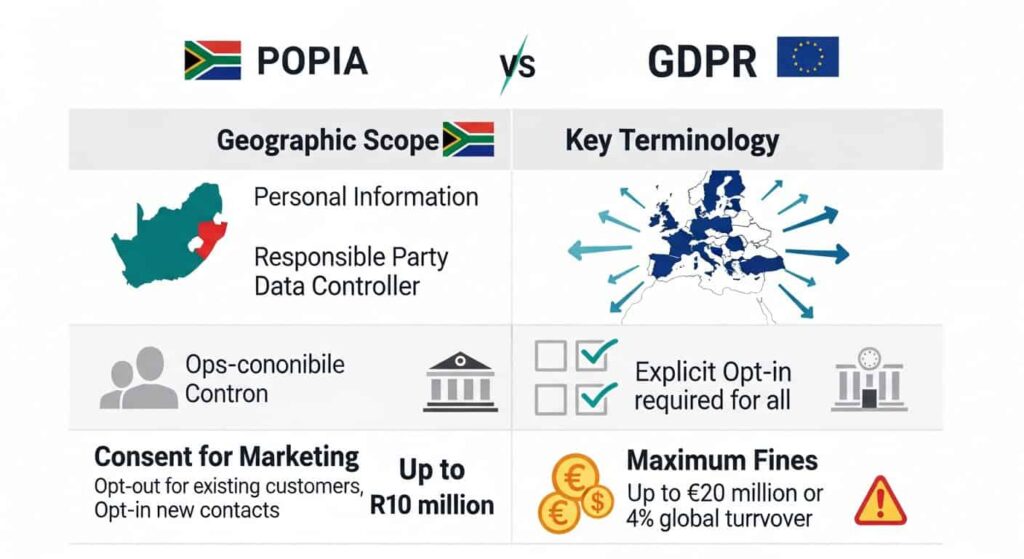
The Protection of Personal Information Act (POPIA) and the General Data Protection Regulation (GDPR) represent significant milestones in the global movement towards enhanced data protection. While POPIA specifically governs the processing of personal information within South Africa, its principles often align with international standards. GDPR, on the other hand, has become the de facto global benchmark, influencing data protection laws worldwide due to its broad scope and stringent requirements. Both regulations aim to grant individuals greater control over their personal data and impose clear obligations on organisations that process this data. For marketers operating in a globalised digital environment, understanding both POPIA and GDPR is crucial, as non-compliance can carry substantial consequences regardless of an organisation’s geographical location if it processes data of South African or EU residents. Navigating these regulations requires a proactive approach to data management, ensuring that all marketing activities are conducted with privacy at their core.
Understanding the Regulatory Landscape: POPIA & GDPR Essentials for Marketers
Navigating the complex world of data privacy regulations requires a clear understanding of the foundational laws and key concepts. POPIA and GDPR, while distinct in their geographical focus, share many core principles aimed at protecting individuals’ personal information.
What is POPIA? The South African Data Protection Law
The Protection of Personal Information Act (POPIA), also referred to as the Personal Information Act, is South Africa’s primary legislation governing the lawful processing of personal information. It applies to any organisation, whether public or private, that processes personal information within South Africa. POPIA aims to protect the fundamental right to privacy by establishing conditions for the responsible processing of personal information. These conditions dictate how organisations must collect, use, store, and share personal data, emphasizing the need for accountability and security. For marketers in South Africa, understanding POPIA is paramount to ensuring that all marketing campaigns and data collection practices are compliant.
What is GDPR? The European Union’s Comprehensive Privacy Law
The General Data Protection Regulation (GDPR) is a comprehensive data privacy law enacted by the European Union. It applies to organisations that process the personal data of individuals residing in the EU, regardless of where the organisation is based. GDPR sets a high standard for data protection, granting EU residents significant rights over their personal data and imposing strict obligations on data controllers and processors. Its influence extends far beyond the EU, as many global organisations adopt GDPR principles to ensure consistent data handling practices across their operations. Marketers must be aware of GDPR if their marketing efforts target individuals within the EU or involve processing their personal data.
Key Concepts Marketers Must Grasp
Effective compliance with POPIA and GDPR hinges on understanding several critical concepts:
- Personal Information/Data: This refers to any information relating to an identifiable natural or juristic person. For marketers, this encompasses a wide range, including names, email addresses, phone numbers, location data, browsing history, IP addresses, and any other data that can directly or indirectly identify an individual.
- Processing: This broad term covers any operation performed on personal information, such as collection, recording, organisation, structuring, storage, adaptation or alteration, retrieval, consultation, use, disclosure by transmission, dissemination or otherwise making available, alignment or combination, restriction, erasure, or destruction. Every marketing interaction involving data constitutes processing.
- Data Subject: This is the individual to whom the personal information relates. Marketers must always remember that they are interacting with data subjects who have rights over their information.
- Consent: A crucial legal basis for processing personal data, consent must be freely given, specific, informed, and unambiguous. Marketers must obtain valid consent before processing personal data for many marketing activities.
The Stakes: Navigating Fines, Reputational Risk, and Legal Actions
Non-compliance with POPIA and GDPR carries significant risks for organisations. Both regulations empower supervisory authorities to impose substantial fines for violations. For instance, GDPR violations can result in fines of up to €20 million or 4% of global annual turnover, whichever is higher. Similarly, POPIA can levy significant fines and even imprisonment for individuals responsible for contraventions. Beyond financial penalties, the reputational damage from a data breach or privacy violation can be devastating. Trust, once lost, is incredibly difficult to regain. This can lead to customer churn, negative publicity, and a diminished brand image. Furthermore, legal actions from data subjects or regulatory bodies can further burden organisations. The shift from a lenient approach to more proactive enforcement by regulators means that organisations can no longer afford to treat data protection as a mere checkbox.
Core Principles: Architecting a Privacy-By-Design Marketing Framework
Adopting a privacy-by-design approach is fundamental to building a marketing strategy that is compliant and consumer-centric. This means embedding privacy considerations into the very fabric of marketing operations from the outset, rather than bolting them on as an afterthought.
Lawfulness, Processing Limitation & Minimisation: Only Collect What You Need
A cornerstone of both POPIA and GDPR is the principle of data minimisation. Organisations must only collect personal information that is adequate, relevant, and not excessive in relation to the purpose for which it is processed. This means marketers should critically evaluate every data point they seek to collect. Is this piece of personal data truly necessary for the intended marketing purpose? Collecting more data than required not only increases compliance risk but also raises questions about an organisation’s motives. Lawfulness dictates that there must be a legitimate legal basis for processing, such as consent, contract, or legitimate interests, and this basis must be clearly established and documented.
Purpose Specification & Further Processing Limitation: Clear Intent, No Scope Creep
Marketers must clearly define and document the specific purposes for which they intend to process personal information. This purpose must be communicated transparently to the data subject. Crucially, personal data collected for one specific purpose should not be further processed in a manner incompatible with that original purpose without obtaining further consent or establishing another legal basis. For example, if an email address is collected for a newsletter subscription, it should not subsequently be used for unrelated third-party promotions without explicit consent. This principle prevents scope creep and ensures that data is used ethically and as intended by the data subject.
Transparency & Openness: Building Trust Through Clear Communication
Transparency is vital for building trust in a privacy-conscious world. Organisations must be open and honest with data subjects about how their personal information is collected, used, and protected. This involves providing clear, concise, and easily accessible privacy notices that explain the purposes of processing, the types of data collected, the legal basis for processing, who the data may be shared with, and the data subject’s rights. For marketers, this means ensuring website privacy policies are comprehensive, consent requests are clear, and any marketing communications do not mislead or deceive. Openness fosters a positive relationship and demonstrates respect for individuals’ privacy.
Accountability & Security Measures: Protecting Customer Data as an Asset
Organisations have a legal and ethical obligation to demonstrate accountability for their data processing activities. This involves implementing appropriate technical and organisational measures to ensure the security and confidentiality of personal information. These measures are designed to prevent unauthorised access, disclosure, alteration, or destruction of personal data. For marketing teams, this translates to robust data security practices, secure storage of customer databases, access controls, and regular security assessments of marketing technology platforms. Treating personal data as a valuable asset that requires diligent protection is essential for maintaining compliance and safeguarding customer trust.
Consent: The Cornerstone of Ethical Marketing Engagement
Consent is a pivotal element in POPIA and GDPR, particularly for marketing activities. Obtaining valid consent is not merely a bureaucratic step; it’s a fundamental aspect of respecting individual autonomy and building genuine engagement.
The Gold Standard: Obtaining Valid, Freely Given, Specific, Informed, and Unambiguous Consent
For consent to be considered valid under both POPIA and GDPR, it must meet stringent criteria. It must be freely given, meaning individuals cannot be coerced or pressured into agreeing. It must be specific, referring to particular processing purposes, and informed, with individuals understanding what they are consenting to. Finally, it must be unambiguous, often requiring a clear affirmative action (e.g., ticking a box, not pre-ticked). Silence, pre-ticked boxes, or inactivity do not constitute valid consent. Marketers must ensure their consent mechanisms are robust and clearly explain the purpose of data processing for marketing.
Direct Marketing under POPIA & GDPR: Navigating the Nuances
Direct marketing is an area where consent requirements are particularly strict. Under POPIA, for direct marketing purposes, organisations must obtain the data subject’s consent. While POPIA allows for “soft opt-in” where consent is implied from a previous customer relationship or business dealings, this must be communicated clearly and the individual must have the opportunity to opt-out. GDPR generally requires explicit consent for direct marketing, especially for electronic communications like emails, unless a specific exemption applies (like the one similar to POPIA’s soft opt-in for existing customers, though still requiring an opt-out). Marketers must be diligent in ensuring they have valid consent before sending promotional materials.
Managing Consent: Records, Withdrawals, and Data Subject Rights
Effective consent management is an ongoing process. Organisations must maintain clear records of the consent obtained, including the date, time, and the specific purpose for which consent was given. Crucially, data subjects have the right to withdraw their consent at any time, and organisations must make this process as easy as withdrawing consent. This means providing clear opt-out mechanisms in all marketing communications and honouring withdrawal requests promptly. Honouring these rights reinforces transparency and trust, ensuring that individuals feel in control of their personal information.
Reimagining Marketing Channels in a Privacy-First World
The advent of robust data privacy regulations necessitates a fundamental re-evaluation of how marketing channels are utilised. Marketers must adapt their strategies to align with privacy principles, transforming how they engage with consumers.
Website & Digital Analytics: Cookies, Tracking, and User Control
Website analytics tools often rely on cookies and other tracking technologies to gather data about user behaviour. Under regulations like GDPR, explicit consent is generally required before placing non-essential cookies on a user’s device. This means implementing clear cookie banners that allow users to accept or reject specific categories of cookies. Marketers need to understand which cookies are essential for website functionality and which are used for analytics, advertising, or personalization, ensuring transparent communication and user control over their data.
Email Marketing & CRM: Building Compliant Databases and Campaigns
Building and maintaining compliant email marketing databases is crucial. This involves obtaining explicit consent before adding individuals to mailing lists. Importing purchased lists or using pre-checked opt-in boxes without clear affirmative action is not compliant. Customer Relationship Management (CRM) systems must also be configured to track consent status accurately, ensuring that only individuals who have consented receive marketing communications. Opt-out options must be clearly visible and functional in all email campaigns.
Social Media & Targeted Advertising: Data Sharing and Platform Compliance
Targeted advertising on social media platforms often relies on sharing data with these platforms to create custom audiences or lookalike audiences. Marketers must ensure they have the necessary legal basis (usually consent) to share personal information with these third parties. Furthermore, they need to understand the privacy policies of the platforms they use and ensure their advertising practices align with both platform terms and regulatory requirements. Transparency regarding data sharing and ad targeting is increasingly important.
Personalization, AI, and Automated Decision-Making: Ethical Use of Customer Data
Personalization, Artificial Intelligence (AI), and automated decision-making can enhance marketing effectiveness, but they also raise significant privacy concerns. The use of AI for marketing must be transparent, and individuals should be informed when automated decisions significantly affect them. Marketers must ensure that AI algorithms do not perpetuate bias or discrimination. The processing of personal data for these advanced applications must be based on a valid legal ground and conducted with a commitment to fairness and ethical considerations, avoiding intrusive practices.
Data Transfers: Global Reach with Local Compliance
For organisations operating internationally, transferring personal data across borders is a common marketing practice. Both POPIA and GDPR have strict rules regarding the transfer of personal information outside of their respective jurisdictions. Organisations must ensure that such transfers are protected by adequate safeguards, such as standard contractual clauses, binding corporate rules, or explicit consent from the data subject. Marketers need to work closely with legal and compliance teams to ensure all cross-border data transfers for marketing purposes meet these stringent requirements.
Operationalizing Privacy: Practical Steps for Marketing Teams
Integrating data privacy into marketing operations requires a structured, ongoing effort. It involves implementing specific processes and fostering a culture of privacy awareness within the marketing department.
Conducting Data Protection Impact Assessments (DPIA): Proactive Risk Mitigation
A Data Protection Impact Assessment (DPIA) is a process to systematically identify, assess, and mitigate data protection risks associated with a planned marketing initiative or project. For any new marketing technology, campaign, or data processing activity that is likely to result in a high risk to individuals’ rights and freedoms, a DPIA should be conducted. This proactive approach helps marketers identify potential privacy issues early on and implement safeguards before launching.
Vendor Management: Vetting Your Marketing Tech Stack
The marketing technology (martech) stack often involves numerous third-party vendors who process personal data. It is crucial for marketing teams to conduct thorough due diligence on these vendors. This includes reviewing their privacy policies, security measures, and their own compliance with POPIA and GDPR. Service agreements should clearly define data processing responsibilities and include data protection clauses to ensure vendors meet the organisation’s compliance standards.
Information Officer / Data Protection Officer: Understanding Key Roles
Understanding the roles of the Information Officer (under POPIA) or Data Protection Officer (DPO under GDPR) is essential for marketing teams. These individuals are responsible for overseeing data protection compliance. Marketers should collaborate closely with these officers, seeking guidance on privacy-related matters, reporting potential breaches, and ensuring that marketing strategies align with regulatory requirements and internal privacy policies.
Data Breach Response & Notification: Protecting Your Brand When Things Go Wrong
Despite best efforts, data breaches can occur. Marketing teams must be prepared to respond effectively. This involves having a clear data breach response plan that outlines steps for containment, investigation, and notification. POPIA and GDPR mandate timely notification to supervisory authorities and, in some cases, to the affected data subjects. Marketing departments play a key role in communicating transparently with customers during a breach, which is critical for mitigating reputational damage.
Training & Awareness: Empowering Your Marketing Department
Continuous training and awareness programs are vital to embed a privacy-first mindset within the marketing department. Marketers need to understand the principles of POPIA and GDPR, the organisation’s data protection policies, and their individual responsibilities. Regular training sessions, workshops, and accessible resources can empower marketing teams to make privacy-conscious decisions in their daily work, fostering a culture where data privacy is a shared responsibility.
Conclusion: Embracing the Future of Marketing with Confidence
The impact of POPIA and GDPR on marketing strategies is profound, shifting the focus from aggressive data acquisition to responsible data stewardship. Embracing data privacy is no longer a burdensome legal obligation but a strategic imperative that builds trust, enhances brand reputation, and ultimately drives more effective and sustainable marketing outcomes. By understanding the core principles, prioritizing consent, reimagining channel strategies, and operationalizing privacy within their daily workflows, marketing teams can not only achieve compliance but also gain a significant competitive advantage. The future of marketing lies in building genuine relationships based on transparency, respect, and unwavering commitment to protecting personal information. Proactive adoption of privacy-by-design principles will empower organisations to navigate the evolving regulatory landscape with confidence, fostering loyalty and ensuring long-term success in a privacy-aware world.